Posts

Week 13 Blog Update on Progress

What is left to do? What challenges have you faced? Will you be able to meet your timeline for completion? Why or why not? Will you be able to implement? Evaluate? This week I finished all of the content that was needed on my course, and I am happy with where it is at the moment.  I think everything that I have created will achieve all of the learning goals that I set for at the start of the creation, but I know I haven’t created a perfect course.  That’s why I’m excited for it to be implemented so I can evaluate the effectiveness of the course.   The peer reviews that I have received have been very helpful and they pointed out things that I did not see.  Fresh eyes and eyes of someone who doesn’t have any background in the subject was very helpful at finding things that weren’t clear in the way that I presented them.   The most difficult things I have encountered were sticking to a plan and not always trying to improve it.  I would start out with...
Week 11 blog post

Prompt: What technology challenges have you faced? What “people” challenges have you faced? How have you sought to overcome these difficulties? What have you learned about completing a major project within a professional deadline? What will you do differently next time? What were your strengths as a designer? What do you need to improve? So far, from a technology point of view, I have encountered very few challenges.  I had to learn some ins and outs of the LMS and how it can function in the way that I wanted it to.  For example, a I wanted to create a more interesting overview page for each of my modules.  With the background in web design, I found that I could use HTML inline styes to create a design for the pages.  This gave me some freedom to edit the look, but because of the way the pages are built, I had to span and div most things, and then give them each their new style.  This wasn’t really difficult, but time consuming and a little tedious.   ...

Week 10 - LTEC 5510

Prompt: What is left to do? What challenges have you faced? Will you be able to meet your timeline for completion? Why or why not? Will you be able to implement? Evaluate? To this point I have most of the “content” of the course created.  The content is covered and the course design has been tweaked enough, and currently lies at a point that I am comfortable with.   The main thing I am now working on is trying to make the content more engaging.  A lot of work needs can be done to create a more engaging, and unique course.  I want to make more videos and graphics, and create more examples and exemplars for the course.   A specific challenge I have recently overcome was one of order of instruction.  I was looking for a good place to introduce the final projects different types of media without adding too much to any one module.  I found I could tie in that subject with “linear vs non-linear media” module very easily.  The problem lied with...

Week 8 - Peer Reviews and how to Improve on your Design

 Prompt: What feedback have you received and what have you done as a result? Why? Given that many standard corporate ID projects last about 3 weeks and this is week 8 of the session, how do you feel about working on a professional timeline? Here is some of the feedback I have received and what I plan to do as a result to the specific feedback.   Feedback: Adding additional multimedia content to help flow of modules Response: Planning on adding some videos and more graphic/picture elements once all the basic content it up.  Feedback: Will the course include a discussion component.  Response: Planning on putting a module discussion boards in each overview for the students to have a place to ask each other questions.   Feedback: Some questions over timelines and how to self regulate the pace of the students.   Response: Will include a more detailed timeline of the course in the syllabus and add a suggested timeline in each overview.   ...

Week 7 - Design Structure of LMS and check up on design model effectiveness

 Prompt: Have you had to make revisions to your design based on the structure of the LMS? How well is the design model working for you? The design model is working well for me so far, but I know I have some challenging things ahead of me with some things I want to design.  I am trying to keep that in mind when it comes to the effort and how specific things I want to do will be able to play out on Canvas in an asynchronous model.   The LMS itself is becoming more and more familiar.  I’ve learned to structure files uploads and assignments based on the modules they are going to go with, which I’m hoping will make grading, assessments and catch up work/late work easier to deal with in the future for the students.  I do wish Canvas didn’t just put all the assignments in one drop down when you are trying to link to them on the pages, but I am glad they have the ability to do that at all.   I do find myself making small changes to my design based on the ...

Week 6 Blog - Thoughts on creating on Canvas

Prompt: What has gone well? What has challenged you? What feedback have you received? What feedback have you given? What have you learned from the process of developing instruction in an LMS? Developing a whole course online, using the LMS Canvas has been something I have been doing a lot of lately.  My district just recently  switched from no required LMS, to Canvas.  Now everybody has to have their courses created and put through the Canvas LMS.   It was a very large learning curve at first, even though I thought it wouldn't be for me as I had been using google classroom much more than most of peers were.  I thought I already had the whole online class creation thing down, but I struggled at first.  The biggest process for me was creating something in Canvas that made my life easier at once it was done.  Creating an assignment is simple, but creating an assignment that has built in reteach moments, and grading was something I had to learn how to...

LTECH 5510 - Week 4 Blog - Different Instructional Design Model - Component Display Theory

Image
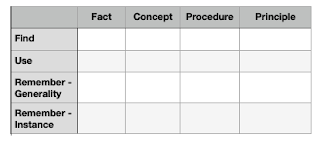
Prompt: answer and discuss the following: What was the model What is the point of the model? How is the model different from what you already know? How is it the same? Is this model something you may use? Why or why not? How is an ID model different from a theoretical model (i.e. social constructivism)? Why is this distinction important? Do you think such a differentiation will matter for a client? What was the model Component Display Theory (CDT) What is the point of the model The point of the component display theory is that “instructional outcomes, represented either by objectives or test items, can be classified on two dimensions: student performance (Remember-Instance, Remember-Generality, Use, and Find) and subject matter content (Fact, Concept, Procedure, and Principle).”  (Merrill 1994).  This theory can be represented by a grid or matrix, where each set of performance task can be put into it.  Like such:  Each performance task/question will be attempting to ...

LTEC 5510 - Week 3 Blog - Thoughts on Revision.

 Prompt: Based upon your experience revising your instructional design document this week, reflect on what you learned from your peer's feedback. What did you learn about your work? What did you change as a result? What did you not change? Why I have always found that peer's feedback can be one of the most useful things in writing just about anything.  It is also one of the more difficult things for me to do as well.  The obvious chance for improvement before assessment or public viewing that peer feedback brings to the table is an invaluable part of the writing process.   For this case, my peer review consisted of a couple of parts.  I exchanged my Design Document for the course I am working on with a few classmates, and I got a chance to review each of them.  While we are designing a course for this class, we are doing it on different subjects, and thus none of us are by no means experts on the others topic.  This allows us all to give hone...

Week 1 - LTEC 5510 - Article reflections

  Write a blog reflection about what you learned from your three readings and note items, theories, and elements that you would like to know more about and whether it impacts your design or tells you more about how you learn.  The first article talked in-depth about an example and look at Problem Based Learning, and how it’s iterative process works with the constructive theory of learning.   I really liked, and use as often as I can, the idea of putting learners in an authentic situation where they are “constructors of their own knowledge in a context which is similar to the context in which they would apply that knowledge.” (Savery, Duffy 1995) I like it’s real world application process, where all of the learning revolves around solving a problem.   The 2nd article that I choose to do some research on is a study of the effectiveness of discussion forums in online learning vs face to face learning.   The learning I took from this is while the goal of a discussio...

Week 14 Reflections part 2

Examine your design plan for your final project in the course. Which principle(s) of multimedia learning could be implemented in your proposed instructional materials?  What could you use from the Method of Loci? Explain how you would apply the principle(s) of multimedia learning into your proposed design. In my instructional design I place to use a couple of these principles.  The interactive google slides will have the temporal contiguity principle, where words and pictures are presented together.  Multimedia principle, where the students will be able to choose picture examples of their work.  The main focus will be attempting to follow the Personalization Principle - where they will be able to personalize each lesson by selecting images and answers from their own life, and in their own words. 

Week 14 Reflections part 1

Prompt 1: Reflect on the Method of Loci in your blog. What worked? What didn't? How could you use such a cognitive activity, mental or visible to users, to improve the acquisition of knowledge in your designs? What was different last time vs. this time? Did what you built before stimulate this kind of visualization in learners or did the media do it for them? Which do you think is better? I have enjoyed attempting the Method of Loci, and have really started to see some results from it.  It's enjoyable to me to try and find something that relates to what I am trying to remember as a visual for a particular part of the room.  What can I think of that reminds me of a learning community that has its own values?  How about a desk (learning community) with a scale on it (value)?  Now it also has a check for $1,000 on it (desired outcomes) and a picture of two people shaking hands (acceptable conventions and practices).  I have now created a visual representation o...

Week 12 Reflections

Prompt:What does it mean to manage/regulate yourself (self-regulate) and others during learning experiences? How does it bring you towards goals? How important is communication in this process and what helps/impedes it? I have always looked at self regulation as once of the more difficult things for me to handle when it comes to learning experiences.  When I am the facilitator or teacher, I have the likelihood to rush through things I have already done, or think the students should have already learned.  Taking time to go back and remember that this is the first time some of these kids are hearing this, or that hearing it just one time is not enough for all kids to understand it is a difficult thing for me to remember. When it comes to others, I have a much better understanding how to regulate experiences.  Frequent checks for understanding and personal questions of motivation are used my class often.  Often times I use simple visual cue for understanding such as...
Reflect on your experiences creating Project A from start to finish. What worked and what did not? What do you think was the strongest aspect of the design process? The weakest? How do you think the experience will effect you on Project B? I would like to start my reflection by saying this was a very rewarding process.  I have been writing curriculum for many years at my current job, but I have never done so with as much purpose and structure as this instructional design course has laid out. Being a very data driven person, learning about how to look at data before you start, pick the data that best represents the goal you are trying to reach, and then using that data as the backbone for what kind of curriculum you create was a very logical system.  The analysis report really allowed me to understand what was happening currently for my client, and what needed to be done by the end of this.  The design and development process were the ones that I was most famili...

Covid 19 and the new classroom.

Prompt - Reflect and share how the current situation related with COVID-19 outbreak has been impacting you and your classwork.  What are the challenges? Any positives? Any visions of how the situation may impact your project, classwork, and career? Covid-19 has changed the way I work,  how I interact with friends, and how I spend my leisure time.  My wife and I are both teachers, and this year our spring breaks fell on different weeks.  Mine was two weeks ago (the same as UNT's) and my wife's was this week, so I have been kind of social distancing for about 2 weeks.  This first week back has been all about setting up what online instruction is going to look like for my district.  We have had trainings on google hangouts/meet, google classroom (our LMS of choice) and I have been asked to write some virtual curriculum for a couple of classes I teach so we can have take some pressure off fellow teachers next week when kids come back.  It's bee inter...

Method of Loci and implementation and evaluation

Prompt 1: Reflect on the Method of Loci in your blog. What worked? What didn't? How could you use such a cognitive activity, mental or visible to users, to improve the acquisition of knowledge in your designs? Write a blog entry on this.  The first time I heard about the idea of a "mind" palace was watching the hit BBC TV show Sherlock, with Benedict Cumberbatch.  Oftentimes in this show, when Sherlock wanted to remember a minute detail from an encounter, he would go to his "mind palace" and pull the memory from there.  At first I thought this was just a TV plot device that would explain his almost un-human like ability to remember even the smallest of details.  A cleaver trick by the show writers to make the main character more relatable to people who couldn't do what he did. It wasn't until starting this masters program that I thought I found out this was indeed a real method that anyone can use to help them remember certain things.  While the show...

Thoughts on instructional Design

Prompt: What are your thoughts so far on Instructional Design?  My thoughts on instructional design so far is that it all makes perfect sense.  Instructional Design is process of finding a problem, finding the root of that problem, and then coming up with actionable pathways to come to a solution to that problem.  I had never really put as much thought into the root of problems, and how they are affected by the situations and circumstances that surround them.  Thinking like a client, that has a goal they want to achieve, and then coming up with the best and most efficient ways to achieve that goal is a way of looking at things I had not done to the degree that has been required of me until this class.  It has been incredibly rewarding. Starting with client meeting report, where the problem is identified.  Then looking at the reflective analysis, and the finding report that helped shed light on why the problem is a problem, and understanding it completel...
Week 4 Reflections: Prompt 1: What have you learned from the analysis? What are you planning to do with it? Do a little brainstorming about what activities tied to your learning objectives that you might include in the design of your lesson. I have learned many things from doing the analysis and the design about this project.  I have learned much about the process of creating meaning instructional design.  First identifying a problem, and then looking at the data as why that is a problem was the first wow step for me.  It's simple in idea, but understanding what exactly is going wrong with something, really starts to open up ideas and paths to fixing the problem that may not have been apparent at the beginning of the initial client interview.  The next "ah ha!" moment was shedding light on the idea that to fix the problem you have found, you need to first better understand what you want the end product to look like.  We have been taught most of my educatio...

Week 2 Reflections: Updated personal learning theory

Prompt: "How has your personal theory of learning changed? How has it evolved? What caused that change?" Explanation: My learning Philosophy is pasted below.  It's a simple concept that attempts to answer what is the best way that learning happens, and hopefully the most successful way for me as a teacher to active that learning.  My theory about learning has not changed much over the past year, but there has been a lot of information that I have learned that has explained why  my theory is what is, with backing of studies and peer reviewed articles.  This version below was updated with parts about learning design, which even though I am just in the first few weeks of the class, I can already see why its a thing, and it's importance to the overall idea of how learning happens.  In fact this pre planing, overall look of how the learning will happen has inspired me to look at my current teaching with a designers view and not just a teacher view.  Look at w...

Real world instructional design

Prompt: Go out into the world (e.g., grocery store, mall, etc.) and locate two examples of instructional design in which you, the viewer/reader, are expected to learn something. What were the goals of the instruction? How effective was it? What are three things you learned that you are not likely to forget? My first example of running into, and experiencing instructional design in the "real world," came when I was at the gym, attempting to keep my annual new years resolution of getting back into shape.  When I hopped on to a treadmill, it donned on me that I have never truly experienced someone showing me how to use a treadmill, but it was something that's interface was designed to train you how to use it.   According  to Piskurich "the purpose of instructional design is to provide both an appropriate destination, and the right road to get you there," (Piskurich 2015) and this treadmill interface does just that.   The person running takes...